Home › Services
Reading pavement failure in a hot, wet climate
Every failure on a parking lot leaves evidence of what caused it. Across metro Atlanta the causes come down to a short list: summer heat working on a loaded surface, rainwater reaching the red clay underneath, sun aging the binder, and tree roots or open edges taking support away. Read the pattern correctly and the right repair method follows from it.
Why the pattern tells you more than the size of the damage
Property managers tend to describe a problem by how big it is: a bad area near the loading dock, a few holes by the entrance. A contractor who repairs pavement well looks first at shape, location, and texture. A crack that forms a mesh of small blocks means something different from a long straight crack, and a low spot where trucks park means something different from a low spot where water collects after a storm.
The distinction matters because each distress has a depth. Some start at the very top of the surface and stay there. Others start in the aggregate base or the clay subgrade and only show at the surface once the damage below is well along. A repair that reaches the surface layer cannot correct a failure that began two layers down, no matter how neatly it is placed.
Rutting and shoving: heat and load working together
Asphalt is held together by a binder that softens as it warms. On a Georgia afternoon in July or August, a dark surface in full sun gets far hotter than the air above it, and at those temperatures the mix can deform under weight. Rutting shows up as twin grooves in the wheel paths of drive aisles, most often on routes used by delivery trucks, garbage trucks, and buses.
Shoving is the sideways version. Where vehicles brake, turn sharply, or pull away from a stop, the surface gets pushed into ripples or a bulge along the edge of the traffic lane. Look at the approach to a stop bar, the turn into a loading area, and the drive-through lane of a retail pad. If the distortion is confined to those spots and the surrounding pavement is sound, the mix itself is usually the weak point rather than the ground under it.
Depressions under dumpster pads and trailer legs
Some of the worst deformation on commercial lots comes from weight that does not move at all. A loaded dumpster sits on four small wheels or skids, and a parked semi-trailer rests on two narrow landing-gear pads. That load is concentrated on a small area, and on a hot day the asphalt beneath it slowly sinks and spreads. The result is a set of dished holes in a regular pattern, or a broad bowl in front of the enclosure where the collection truck sets down and lifts.
These spots rarely respond to ordinary patching, because the same load returns on the next collection day. The lasting fix in most cases is a concrete pad sized for the container and the truck approach, or a concrete strip where trailers are dropped. Asphalt alone is simply the wrong material for a load that sits still in the heat.
Alligator cracking: rain reaching the base and the clay
Alligator cracking is a network of interconnected cracks forming small, many-sided pieces that resemble reptile skin. It is the clearest sign that the layers beneath the surface have lost their ability to carry load. On the Georgia Piedmont, the usual cause is water. The native soils are weathered clay and silty material over decomposed rock, and they drain slowly. With roughly 50 inches of rain a year and frequent heavy downpours, water that gets through cracks or seeps in from the edges saturates the base and the clay, and saturated clay loses much of its strength.
Once support below weakens, every passing vehicle flexes the surface a little more than it was built to bend. The asphalt fatigues and breaks into the familiar pattern. Check where the cracking sits. If it follows low areas, the downhill side of a sloped lot, or the zone around a clogged inlet, water is the driver, and a repair that ignores drainage will fail in the same place.
Potholes after heavy rain: why they appear and why they return
A pothole is usually alligator cracking that has been left long enough for the pieces to break loose. Traffic knocks the loose fragments out, water pools in the opening, and each storm softens the base a bit more. That is why managers see a burst of new holes right after a week of heavy thunderstorms: the rain did not create the weakness, it finished off pavement that was already cracked through.
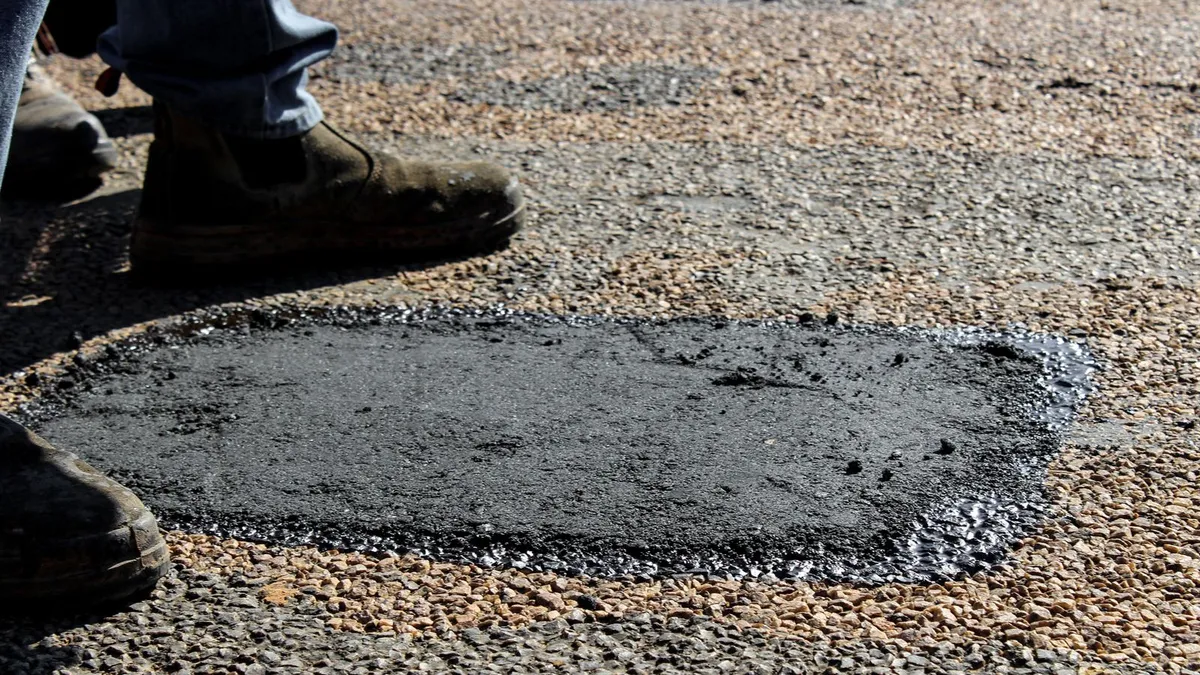
There are three broad ways to fill one, and they reach very different depths.
- Cold patch is a bagged or stockpiled mix placed without heat and tamped into the hole. It is a temporary safety measure for a hazard that cannot wait. It rarely compacts to full density and tends to push out or wash away within a season.
- Hot-mix patching places heated asphalt into a cleaned and squared hole, then compacts it with a roller or plate. It holds far better than cold patch, but if the base under the hole is still wet and soft, it only resurfaces the symptom.
- A full-depth patch removes the failed asphalt and the weakened base below it, cuts the edges square, restores or replaces the base, and rebuilds the section with compacted hot mix. It is the method that corrects a failure that started underneath.
Why the same pothole keeps coming back
A pothole that reappears in the same spot every spring is telling you the repair never reached the cause. Either the patch was only a surface fill over a saturated base, or water keeps getting into that area from a clogged drain, a low spot, or a cracked edge nearby. Ask the contractor to explain where the water enters and how the proposed work stops it, not just how the hole will be filled.
Raveling and block cracking: sun and oxidation
Intense sun and oxygen age asphalt binder over time. The surface fades from black to gray, the binder loses flexibility, and the mix becomes brittle. Two distresses follow. Raveling is the loss of fine material from the surface, leaving loose stones and a rough, pitted texture. Block cracking is a pattern of large rectangular pieces created by the aged surface shrinking as temperatures swing.
Both begin at the top, which is good news. Where the base is still firm and the cracks are not yet wide, these conditions are handled with crack sealing and surface treatment, or with a thin mill-and-overlay once the aging is advanced. Tear-out is rarely needed for oxidation alone.
Edge breakup and root heave: trees and unsupported edges
Metro Atlanta is known for heavy tree cover, and parking lots are often built right up to mature oaks and pines. Roots grow under the pavement toward moisture, lifting the surface into humps and radial cracks near planting islands and property lines. Shade from the same trees keeps nearby pavement damp longer after rain, which adds to the damage.
Edges fail for a related reason. Where the pavement ends at a grass strip or a slope with no curb, nothing holds the edge in place. Runoff on a hilly site erodes the soil beside it, vehicles drive over the unsupported rim, and the asphalt cracks and crumbles inward. Repairs here need root pruning or a root barrier coordinated with an arborist, or rebuilt edges with proper support, before new asphalt goes down.
How the repair method follows the cause
- Surface-only damage from sun and age, with a firm base: crack sealing, surface treatment, or a thin mill-and-overlay.
- Rutting and shoving confined to stop, turn, and truck routes: mill out the deformed mix and replace it with a mix suited to heavy, slow traffic.
- Depressions under dumpsters and trailer pads: remove the damaged area and install a concrete pad sized for the actual load.
- Alligator cracking and potholes from a wet base: full-depth patching, paired with a fix for the water source such as clearing inlets, regrading, or sealing adjacent cracks.
- Root heave and edge breakup: address the roots or the missing edge support first, then rebuild the pavement section.
What to check before asking for a repair proposal
Walk the lot within a day of a heavy rain. Note where water stands, which inlets are clogged with leaves or silt, and whether runoff from a slope crosses the pavement. Mark where damage clusters: truck routes, dumpster enclosures, tree islands, or low corners. When proposals arrive, a good one names the distress in each area, states the repair depth and the base work included, explains any drainage correction, and marks areas that need concrete instead of asphalt. A proposal that lists only square footage and a single patch method has not diagnosed the lot.
Reading pavement failure in a hot, wet climate — common questions
How can I tell if a crack is only on the surface or goes deeper?
Look at the pattern and the ground around it. Long single cracks and large rectangular blocks on an aged, gray surface usually start at the top. A tight mesh of small pieces, especially with a slight sag or standing water nearby, points to a weak base below. If the pavement flexes or pumps fine mud through the cracks after rain, the failure has reached the layers underneath.
Why do potholes show up right after a stretch of heavy storms?
The storms usually finish off pavement that was already cracked through. Water runs into open cracks, soaks the aggregate base and the clay beneath it, and softens the support. Traffic then breaks the loose fragments out. The rain exposes weakness that had been building for months, which is why the same areas tend to fail again unless the base and drainage are corrected.
Is cold patch ever the right choice?
Cold patch is useful as a temporary safety measure when a hole creates a hazard and hot mix is not available right away. It keeps a tire or a foot out of the hole for a while. It does not compact to the density of hot mix and does not address the base, so plan on a proper hot-mix or full-depth repair once the schedule allows.
Why does the pavement keep sinking in front of our dumpster enclosure?
A loaded container and the truck that lifts it put concentrated weight on a small area, and hot asphalt deforms under that kind of load. Patching the dip with more asphalt only resets the clock until the next few collections. The lasting answer in most cases is a concrete pad and apron sized to cover both the container footprint and the spot where the truck sets down.
What does a full-depth patch involve?
The contractor saw-cuts the failed area into a square or rectangle, removes the asphalt and the weakened base below, and checks the subgrade. Soft or wet material is removed or stabilized, new aggregate base is placed and compacted, and hot-mix asphalt goes back in lifts, each one rolled. The finished patch should sit flush with the surrounding surface with tight, sealed edges.
Can tree roots be cut to fix a heaved area?
Sometimes, but it should be decided with an arborist, because cutting large roots close to a trunk can destabilize or kill a mature tree. Options include selective root pruning, installing a root barrier along the pavement edge, or reshaping the parking layout near the tree. The pavement repair itself follows once the root issue is handled, or the heave simply returns.
When is repair no longer worth it compared with repaving?
Repair makes sense while failures are localized and the rest of the lot is sound. When alligator cracking, potholes, and patched areas cover a large share of the lot, or when drainage problems affect wide sections, piecemeal work tends to chase the same issues year after year. At that point a contractor should evaluate milling and overlay or reconstruction for the worst sections.
Talk through your site
Start with the address, roughly how many square feet, and photographs of the worst areas and anywhere water sits after a storm.
Related work
Parking Lot Paving
New lots and full reconstruction, starting with the clay underneath.
Parking Lot Repair
Sorting an occupied lot into what has to happen now and what can wait.
Sealcoating & Crack Sealing
Protecting binder from Georgia sun, and the limits of what a coat can do.
Milling & Resurfacing
Mill and overlay versus stacking another layer on top of the curbs.
Parking Lot Striping
Re-planning layout and flow instead of repainting old lines.