Home › Services
Sealcoating and crack sealing where the sun does the damage
A fresh black sealcoat makes any parking lot look renewed, which is exactly why it gets bought for the wrong reasons. Under Atlanta sun, a coating does real and useful work on the top of the pavement. It does nothing for what lies below, and it only earns its keep when cracks are sealed first and the weather cooperates.
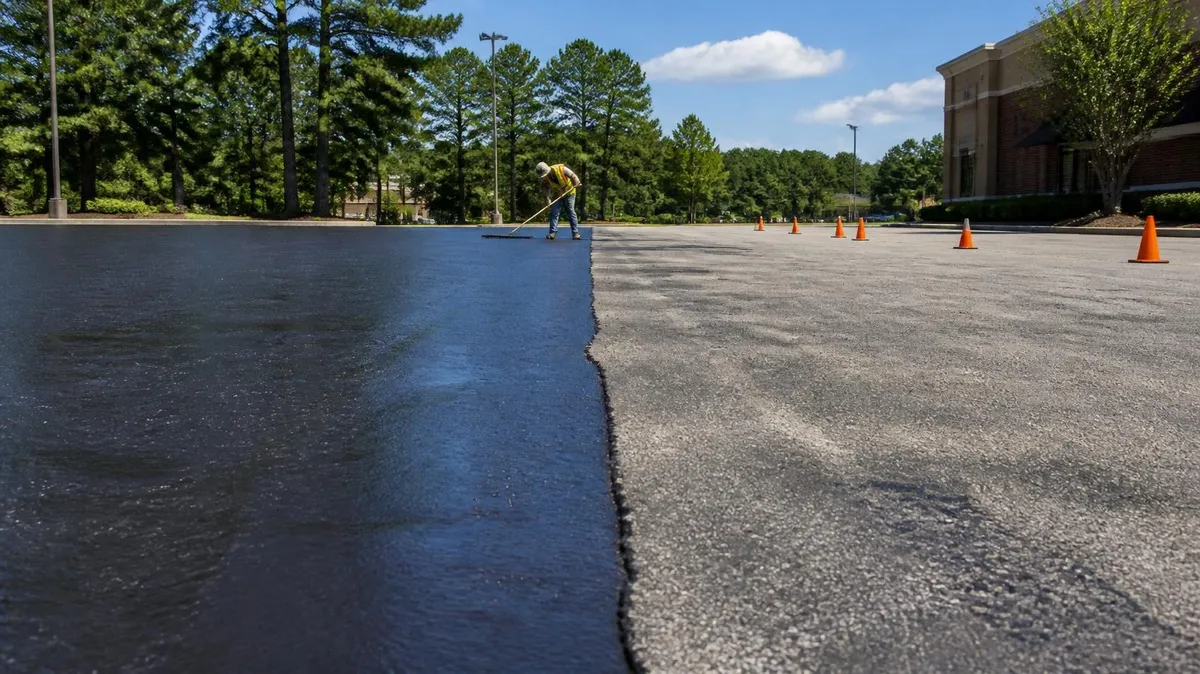
What Georgia sun and oxygen do to asphalt binder
Asphalt pavement is stone held together by a thin film of petroleum binder. Fresh binder is dark, slightly flexible, and sticky enough to keep the stones locked in place. Every day of exposure to ultraviolet light and oxygen changes its chemistry. The lighter, oily fractions are lost, and the remaining binder stiffens. Metro Atlanta combines long, hot summers with intense sun, so that aging moves along steadily from the first year a lot is paved.
You can watch it happen. The surface fades from black to a flat gray. Fine sand-sized particles start to loosen and collect along curb lines and in drainage paths. Small hairline cracks appear, then widen and join into block patterns as the stiffened surface can no longer flex with daily temperature swings. At that point rain has a path into the pavement, and the red clay below does not tolerate being soaked.
What a sealcoat can do, and what it cannot
A sealcoat is a thin liquid coating, usually a refined tar or asphalt emulsion blended with fine sand and additives, spread over the surface. It shields the binder from sun and oxygen, slows the loss of fines, resists spilled fuel and oil to a degree, and seals the smallest surface voids against water. It also restores a uniform dark color that makes fresh striping easy to read.
It is not structural. A coating a fraction of an inch thick adds no load-carrying strength. It does not fill potholes, level ruts, lift depressions, or correct alligator cracking caused by a saturated base. Coating over those failures hides them for a few months and then they reappear, often with the new coating flaking away at the edges. Any area where the pavement flexes, sinks, or breaks into small pieces needs repair before a sealcoat is worth applying there.
Crack sealing comes first
Cracks are the entry points for the water that destroys the base, and a sealcoat alone does not close them. Liquid coating either bridges a crack as a thin skin that splits within weeks, or drains into it without filling it. Proper crack sealing cleans the crack with compressed air or a heat lance, removes vegetation and debris, and fills it with a hot-applied rubberized sealant that stays flexible as the pavement moves.
For wider or working cracks, many contractors rout the crack first to create a clean reservoir so the sealant has more contact area and holds longer. Very wide cracks or cracks with broken edges may need a mastic or a patch instead. Sealant should cure before the sealcoat goes over it, and a good proposal describes the crack work separately from the coating so you can see both were included.
Surface prep: oil spots, leaf litter, and tree sap
Sealcoat only performs if it adheres to clean pavement, and prep is where cut corners show up first. Several local conditions deserve specific attention.
- Oil and fuel spots in parking stalls and at dumpster pads soften asphalt and keep coating from sticking. They should be scraped, cleaned, and treated with an oil-spot primer before coating.
- Leaf litter, pine straw, and seed pods from Atlanta tree canopy collect in corners and along curbs. They must be blown and swept off completely, since coating over organic debris leaves soft patches that peel.
- Tree sap and pollen film under oaks, pines, and sweetgums leave a sticky residue that can prevent adhesion. Heavily coated areas may need washing.
- Dirt and silt washed onto the pavement from slopes and landscape beds after storms must be removed, and edges trimmed back where grass has crept over the asphalt.
Weather windows in an Atlanta summer
Sealcoat needs warm, dry conditions to cure, and Atlanta weather gives mixed signals. Heat speeds curing, but extreme midday surface heat can make some products dry too quickly on top and cure unevenly, so many contractors start early in the day. High humidity slows evaporation of the water in emulsion products. The larger threat is the afternoon thunderstorm. A downpour on uncured sealcoat can wash it off the lot, stain adjoining concrete, and send the residue into inlets.
A careful contractor watches radar, schedules sections that can be finished and cured before storms typically build, and refers to the product data sheet for minimum temperatures and cure times. Vehicles generally stay off for at least several hours and often overnight, depending on conditions. Striping should wait until the coating is fully cured, since paint laid on soft sealcoat can crack, blur, or fail to stick.
How often to reseal, and why more is not better
Resealing is based on wear, not the calendar. Look at the high-traffic aisles and entrances: when the coating has worn through to gray aggregate and the lot has faded again, it is time. For many commercial lots that means every few years, with busier drive lanes wearing faster than parking stalls.
Over-application is a real problem. Each coat adds a layer to the surface, and after years of frequent resealing that buildup can become thick and brittle. It develops a network of fine map cracks, curls, and peels away in sheets, especially in low-traffic stalls where tires never wear it down. Thick buildup also traps water at the surface and can become slippery. Skipping a cycle on lightly used areas, or coating only the drive aisles, is often the smarter choice.
How to judge a sealcoat proposal
- Application rate: the proposal should state a rate per coat consistent with the product manufacturer, not just the number of square feet covered.
- Number of coats: two coats are common for drive aisles and entrances, and some proposals use one coat in lightly used stalls. The count should be stated clearly.
- Sand or aggregate: the amount and type of sand added to the mix affects durability and traction. Ask what is included and at what ratio.
- Crack preparation: the proposal should specify how cracks are cleaned, whether they are routed, and what sealant is used.
- Surface prep: cleaning, oil-spot priming, and edging should be listed, not implied.
- Repairs excluded or included: areas needing patching should be identified and handled before coating.
- Striping plan: confirm when striping will follow and whether the existing layout will be matched or improved.
Phasing an occupied lot
Most commercial lots cannot close entirely. Apartment communities, office parks, retail centers, and churches all need access during work. A good plan divides the lot into sections so residents or tenants always have a path in and a place to park, with barricades and notices posted well ahead.
Common approaches include coating half the drive aisle at a time, working evenings or weekends at office parks, and scheduling around services at churches. Communication matters as much as sequencing. Residents and tenants need clear notice of which areas close and when, what happens to cars left in closed sections, and when the coating will be ready for traffic. A contractor who shows a phasing map in the proposal has thought through the job.
Sealcoating and crack sealing where the sun does the damage — common questions
Will sealcoating fix the cracks in our parking lot?
No. A sealcoat is a thin surface coating, and it cannot fill or hold across cracks that move with the pavement. Liquid coating tends to either skin over a crack and split, or drain into it without sealing it. Cracks need to be cleaned and filled with a flexible hot-applied sealant first, and then the sealcoat protects the surrounding surface from sun and oxidation.
Can sealcoat be applied over potholes or alligator cracking?
It can be, but it should not be. Those failures come from weakened base or saturated clay below the surface, and a coating adds no strength. The damaged areas will keep flexing and breaking, and the fresh coating will crack and flake with them. Repair those areas first, usually with patching or full-depth work, and then coat the lot once the repairs have cured.
How long do we need to keep cars off after sealcoating?
It depends on the product, temperature, humidity, and sun exposure. In warm, dry Atlanta weather, many coatings are ready for light foot traffic within hours and vehicle traffic by the next day. Humid or shaded areas take longer. The contractor should give a specific time based on the product data sheet and the forecast, and keep barricades up until the coating is cured.
What happens if it rains right after the sealcoat goes down?
A heavy rain on uncured sealcoat can wash it off, leave streaks and thin spots, and carry residue onto sidewalks and into storm drains. The affected areas usually need cleaning and a new coat. This is why careful scheduling around afternoon thunderstorms matters so much, and why a proposal should explain how the contractor handles a weather interruption mid-job.
How often should an Atlanta parking lot be resealed?
Base it on the condition of the surface rather than a fixed calendar. When drive aisles and entrances have worn through to gray aggregate and the surface has faded, resealing is due. For many commercial lots that works out to every few years. Lightly used stalls can often skip a cycle, which also helps prevent the buildup that causes cracking and peeling.
Why is our old sealcoat peeling in sheets?
Peeling usually points to too many coats over too many years, application over dirty or oily pavement, or coating applied during poor weather. Thick layers become brittle and lose grip on the asphalt underneath, especially in low-traffic parking stalls where tires never wear them down. The loose material should be removed before any new coating, and future cycles should apply less.
Should striping be done at the same time as sealcoating?
Striping follows sealcoating, but not immediately. The coating must be fully cured before paint goes down, or the lines can crack, smear, or fail to adhere. Many contractors schedule striping for the following day or later, depending on conditions. Plan the traffic closures so the lot stays closed until striping is complete, especially where accessible parking and fire lanes must be marked.
Talk through your site
Start with the address, roughly how many square feet, and photographs of the worst areas and anywhere water sits after a storm.
Related work
Parking Lot Paving
New lots and full reconstruction, starting with the clay underneath.
Parking Lot Repair
Sorting an occupied lot into what has to happen now and what can wait.
Asphalt & Pothole Repair
Reading ruts, potholes and cracking back to the cause before choosing a fix.
Milling & Resurfacing
Mill and overlay versus stacking another layer on top of the curbs.
Parking Lot Striping
Re-planning layout and flow instead of repainting old lines.