Home › Services
Parking lot striping: plan the layout before repainting the lines
Pavement markings are the cheapest part of a parking lot and the part people read every time they drive in. Striping done well tells drivers where to go, where to park and where not to stop. Done by tracing old lines, it can repeat a layout that stopped working years ago.
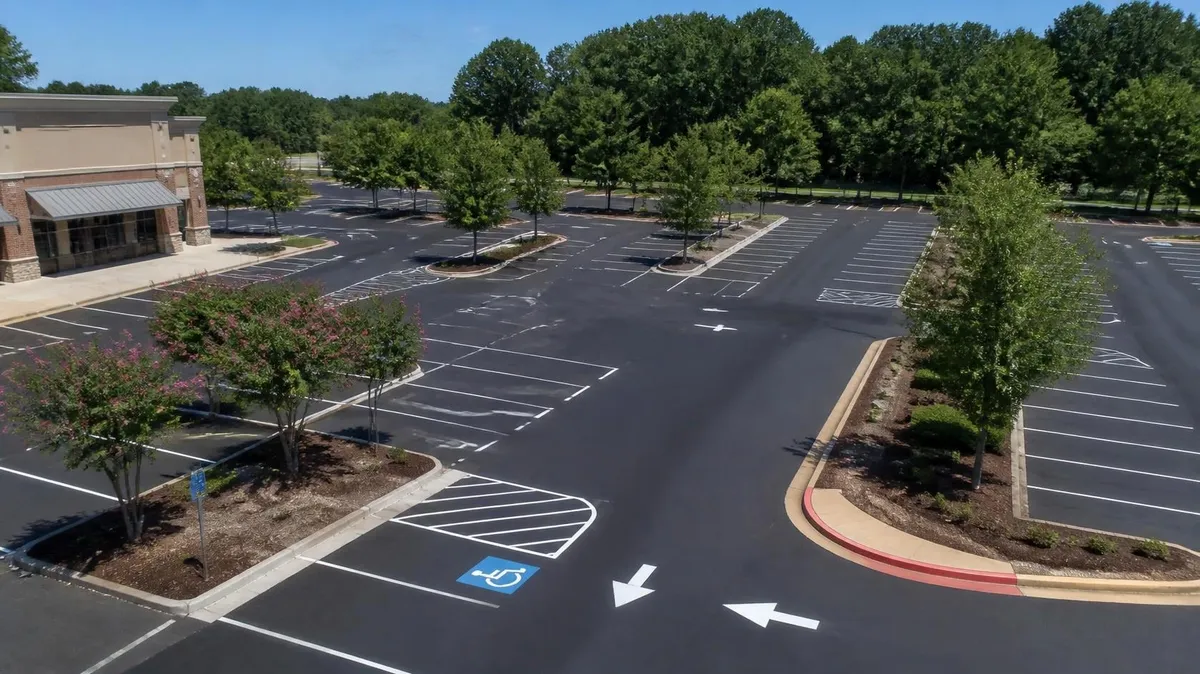
Restriping is a chance to redesign, not just repaint
The simplest restripe traces whatever is already on the pavement. That is fast, and sometimes it is right. But parking lots change use over time. An office building becomes a medical practice with more short visits. A retail center adds a restaurant with takeout pickup. An apartment community sees more delivery vans and larger vehicles than the lot was drawn for. The old lines reflect the old needs.
Before a lot is sealcoated or resurfaced, the markings are about to be covered anyway, which makes it the natural time to ask whether the layout still works. A fresh black surface is a blank sheet. Repainting the old pattern onto it throws that opportunity away.
Signs the current layout is not working
Spend a busy hour watching the lot. How drivers actually behave is the best evidence of where the markings are failing them.
- Cars routinely parked across two stalls or angled into the drive aisle.
- Drivers cutting diagonally across rows instead of following the aisles.
- Near misses at an intersection of aisles with no stop bar or arrow.
- Wrong-way traffic in one-way aisles designed for angled parking.
- Delivery trucks stopping in a fire lane because no loading area is marked.
- Congestion at a single entrance while another sits unused.
- Stalls too short for the pickups and SUVs that now fill them, with bumpers hanging into the aisle.
Re-planning stalls and traffic flow
A layout review looks at stall width and angle, aisle width, one-way versus two-way circulation, and where people walk. Angled stalls with one-way aisles can move traffic smoothly on narrow lots, while ninety-degree stalls with two-way aisles tend to hold more cars where space allows. The best choice depends on the dimensions of the lot and how people use it, not on what was there before.
Pedestrian paths deserve as much attention as vehicle paths. Crosswalks should connect the places people actually walk from and to: parking rows to entrances, transit stops to doors, and overflow areas to the main building. Stop bars at crossings and clear arrows at entrances reduce the number of decisions a driver has to make while also watching for people on foot.
Any change to the stall count or layout can affect the number of spaces a property is expected to provide under its zoning approvals or leases, so the owner should confirm that a new layout does not reduce parking below what is required or promised to tenants. A contractor can draw a proposed layout; the owner is the one who confirms it meets the property's obligations.
Accessible parking and fire lanes
Accessible parking stalls, their access aisles, the signs that identify them, and the route from those stalls to the building entrance are governed by federal and state accessibility rules. Fire lanes, their markings and any no-parking signage are set by the local fire marshal. The details of both can change, and they can differ between jurisdictions across the metro.
The property owner should confirm current requirements with the appropriate authority before a layout is finalized, especially if stall counts, entrances or building uses have changed since the lot was last marked. A good proposal will show where accessible stalls, access aisles and fire lanes will be placed, and should note that the owner has confirmed those locations and markings. Simply repainting old accessible stalls in the same place does not mean they still meet the current rules, particularly if the pavement slope at those stalls has shifted or the route to the door now crosses a raised edge.
Paint or thermoplastic in Georgia heat and sun
Most parking lot striping uses traffic paint, applied by a striping machine that sprays a consistent line width. Waterborne acrylic paints are the common choice for parking lots. They dry quickly, clean up easily, and handle the region's humid summers well when applied under the right conditions. Solvent-based paints dry in cooler, damper weather but are used less often today.
Thermoplastic is a different product. It is a solid material heated until molten and applied in a thick layer that fuses to the pavement as it cools. It lasts much longer than paint and resists wear under heavy traffic, which makes it common for crosswalks, stop bars, arrows and high-traffic entrances. It also costs more to apply and is harder to remove if the layout changes later.
A practical mix for many Atlanta lots is paint for stall lines, which see little direct tire traffic, and thermoplastic for crosswalks, stop bars and legends at busy entrances, where cars run over the markings constantly.
Cure time after sealcoat and new asphalt
Striping should not go down on sealcoat that has not cured. Paint placed over soft sealer can crack, lift or bleed as the coating underneath finishes drying. Sealcoat typically needs a warm, dry day to cure before it can take traffic and paint, and humidity or cloud cover slows that down. A contractor should schedule the striping pass only after the sealer has cured, even if that means coming back the following day.
Fresh hot-mix asphalt has its own timing. New pavement has oils on the surface that can affect paint adhesion, and many contractors wait some days after paving before permanent striping. Temporary markings may be used in the meantime to keep the lot usable. Ask how the proposal handles the gap between paving or sealing and final lines.
Reflectivity, glass beads, stencils and arrows
Lines that look bright at noon can nearly vanish at night or in rain. Reflective glass beads dropped into wet paint catch headlights and bounce light back toward the driver, which makes lines, arrows and crosswalks easier to see after dark. They are especially worth specifying at entrances, drive-through lanes, fire lanes and anywhere pedestrians cross.
Stencils carry the rest of the message: directional arrows, stop bars, the word STOP, accessible parking symbols, reserved or visitor labels, and loading zone markings. Each one should be placed where a driver needs the information, not where it happens to fit. An arrow painted after the point where a driver has already turned the wrong way helps no one.
Scheduling striping in an occupied lot
Striping is quick compared with paving, but the lines still need time to dry before cars drive over them, and the machine needs empty stalls to work. For offices, that often means evenings or weekends. For retail centers, early mornings before stores open. Apartment communities are the hardest because residents park overnight, so the work is usually done in sections with advance notice and cones.
A good schedule clears each section in advance, stripes it, keeps it closed until the paint has set, and then reopens it before moving on. Rain in the forecast is a reason to reschedule, since water on fresh paint can wash or streak it before it sets.
How fading sets the restripe cycle
In metro Atlanta, the biggest factor wearing down lines is not snowplows or salt but sun and tires. Strong ultraviolet light breaks down the paint binder, the color dulls, and the reflective beads loosen and wash out. Tire traffic grinds the markings at entrances, turning areas and drive aisles much faster than at the back of a stall.
That uneven wear means a lot rarely fades all at once. Entrance arrows and crosswalks may need attention well before the stall lines at the far end of the lot. Many property managers restripe on the same cycle as sealcoating, since the new sealer covers the old lines anyway, and do spot touch-ups of high-traffic markings in between. The right cycle for a particular lot comes from looking at it: if lines are hard to see at dusk or after a rain, they are due.
Parking lot striping — common questions
Should I keep the same stall layout when I restripe?
Only if it still works. Watch how people use the lot during a busy period. If drivers cut across rows, park crooked, stop in fire lanes or struggle at entrances, a revised layout will probably serve the property better. Restriping after sealcoat or resurfacing is the best moment to make changes, since the old lines are already covered. Confirm any change in stall count against zoning approvals and tenant commitments.
Who decides where accessible parking stalls and fire lanes go?
The requirements for accessible parking come from federal and state accessibility rules, and fire lane requirements come from the local fire marshal. A contractor can lay out and paint the markings, but the property owner is responsible for confirming the current requirements with the proper authorities. That is especially important if the building use, entrances or number of spaces has changed since the lot was last marked.
Is thermoplastic worth it for a parking lot?
For some markings, yes. Thermoplastic lasts much longer than paint under heavy traffic and holds up well to heat and sun, making it a strong choice for crosswalks, stop bars, arrows and busy entrance lanes. For ordinary stall lines, which see little tire wear, traffic paint is usually enough. Thermoplastic is harder to remove, so it is best used where the layout is not expected to change.
How long after sealcoating can a lot be striped?
The sealcoat needs to cure first, and cure time depends on temperature, sun, humidity and how heavily the sealer was applied. On a hot, dry day that may happen within the same day, while cooler or cloudy weather can push it to the next. Painting over sealer that is still soft can cause cracking or peeling lines. A proposal should state when striping will happen relative to sealing.
Do glass beads really make a difference?
They do, particularly at night and in wet weather. Glass beads embedded in fresh paint reflect headlights back toward the driver, making lines and arrows visible when plain paint blends into dark pavement. They matter most at entrances, crosswalks, fire lanes and poorly lit areas. Beads wear out over time as traffic and weather loosen them, which is one reason older lines look dull after dark.
Can striping be done without closing the whole lot?
Yes. Most commercial lots are striped in sections, with each area cleared, painted, allowed to dry and then reopened. Offices are often done in the evening or on weekends, retail before stores open, and apartment communities in stages with notice to residents. The schedule should also allow for weather, since rain on fresh paint before it sets can ruin the lines.
How often should a parking lot in Atlanta be restriped?
There is no fixed interval. Strong sun and heavy traffic fade markings unevenly, so entrance arrows and crosswalks usually wear out long before stall lines in quiet corners. Many owners restripe whenever the lot is sealcoated and touch up high-traffic markings in between. A simple test is to look at the lot at dusk or after rain: if drivers would struggle to see the lines, they are due.
Talk through your site
Start with the address, roughly how many square feet, and photographs of the worst areas and anywhere water sits after a storm.
Related work
Parking Lot Paving
New lots and full reconstruction, starting with the clay underneath.
Parking Lot Repair
Sorting an occupied lot into what has to happen now and what can wait.
Asphalt & Pothole Repair
Reading ruts, potholes and cracking back to the cause before choosing a fix.
Sealcoating & Crack Sealing
Protecting binder from Georgia sun, and the limits of what a coat can do.
Milling & Resurfacing
Mill and overlay versus stacking another layer on top of the curbs.