Home › Services
New parking lots and full rebuilds on Piedmont red clay
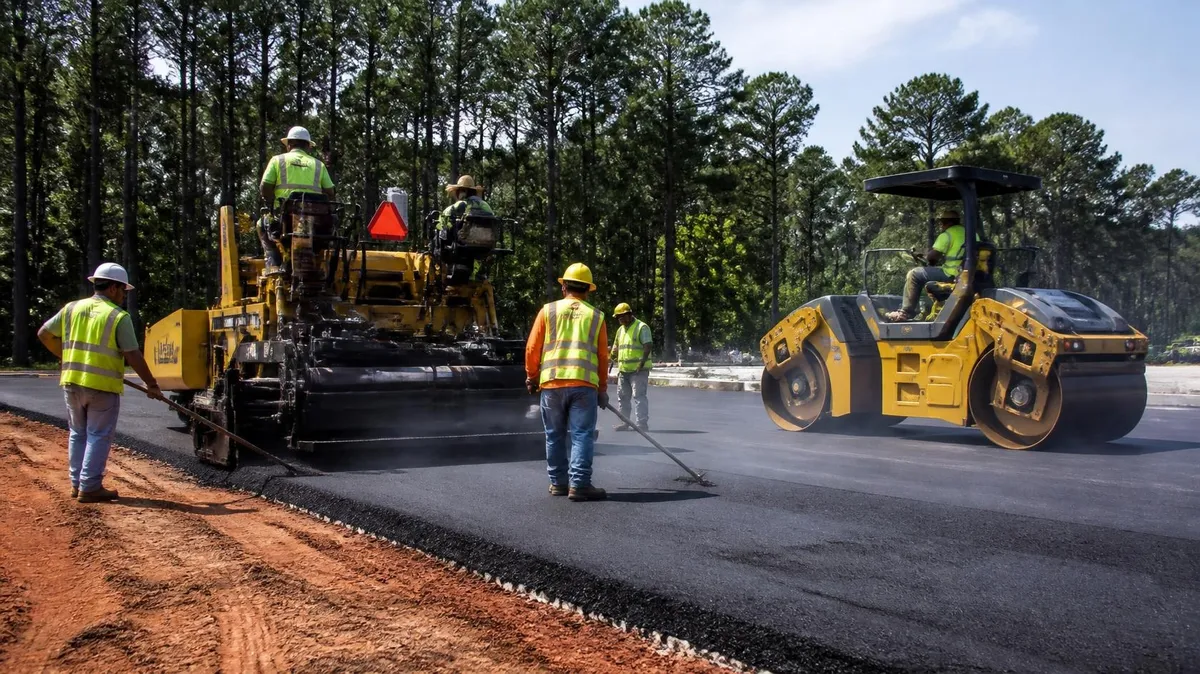
A new parking lot in metro Atlanta is mostly decided in places nobody will see once it opens. The black surface is the last few inches of a structure that starts in the red clay, and the quality of that clay, the stone laid over it and the path the rainwater takes afterward will set the life of the lot far more than the brand of asphalt or the neatness of the striping.
Why the surface is the least important layer
Asphalt is flexible. It does not carry a truck by itself the way a concrete slab bridges across weak ground; it spreads the wheel load outward and downward and hands it to the layers beneath. If those layers are firm, dry and uniform, a modest thickness of asphalt performs for a long time. If they are soft or wet in places, no reasonable amount of asphalt on top will keep the surface from following them down.
That is why two lots paved with the same mix in the same season can age so differently. One was built on clay that had been tested, dried and compacted, with a stone base of full depth and a clear path for water. The other was paved over whatever happened to be there when the grading crew left. For a new lot or a full reconstruction, the useful questions are almost all about the ground.
Subgrade evaluation on Piedmont soils
Most of metro Atlanta sits on weathered residual soil: the familiar red clay and a silty, micaceous material that grades down into saprolite, which is rock that has decomposed in place. These soils can be perfectly serviceable when they are dry and compacted. They drain slowly, though, and they lose a great deal of strength once they are saturated, which in this climate is a question of when rather than if.
Hilly sites add a second complication. Parking areas are often built partly in cut, where the natural ground was excavated, and partly on fill, where soil was brought in and placed. The seam between the two, and any fill that was placed wet or in thick layers, is where soft zones tend to hide.
A careful contractor treats the finished grade as something to be proven rather than assumed. The standard field check is proof-rolling: driving a heavily loaded vehicle slowly across the prepared subgrade in a pattern while someone watches for the ground pumping, rutting or rolling ahead of the tires. Spots that move get marked. Those areas are then either dried and recompacted or undercut, meaning the unsuitable soil is dug out and replaced with stone or better material, and the repaired area is rolled again.
- Ask whether proof-rolling is included and who observes it.
- Ask how soft areas found during proof-rolling will be handled and paid for, since nobody can know their extent before the ground is exposed.
- Ask what happens if the subgrade is too wet to work after a stretch of storms, and whether the schedule allows for drying time.
The aggregate base does most of the work
Between the clay and the asphalt sits a layer of graded aggregate base, crushed stone with a range of particle sizes that locks together when compacted. It spreads load across a wider area of subgrade, gives the paving equipment a firm platform to work against, and keeps the asphalt out of direct contact with a soil that holds moisture.
The two things to confirm are thickness and compaction. Thickness should be stated in the proposal as a compacted depth, not a loose depth, and it should be consistent with the traffic the lot will carry. Compaction should be verified in the field, typically with density testing, before any asphalt goes down. A base that looks level but was only lightly rolled will settle under the first summer of traffic.
The finished base also needs to be graded to the same slopes the pavement will have. Asphalt placed at an even thickness follows the shape beneath it, so a base with a low spot produces a surface with a low spot, and that is where water will stand.
Sizing the pavement to the heaviest vehicle
The most common vehicle in a parking lot is a passenger car, and passenger cars do very little damage. The pavement section should be designed around the heaviest vehicles that use the property regularly: refuse trucks, delivery box trucks, tractor-trailers at a loading area, school buses, fire apparatus and moving vans at an apartment community. A single loaded axle of a heavy truck stresses the pavement far more than a long line of cars.
That is why good designs are not uniform. A typical plan uses a lighter section in car-only stalls and a heavier one along drive aisles, fire lanes, entrance throats and any route that trucks follow to a dock or a dumpster enclosure. Asphalt is placed in lifts, usually a thicker lower lift of coarser mix and a thinner upper lift of finer surface mix, and each lift is compacted separately. A proposal that lists one total thickness for the whole lot, with no mention of lifts or of heavier zones, deserves a follow-up question.
Surfaces that stand up to Atlanta heat
Asphalt softens as it warms, and a long Georgia summer puts dark pavement under intense sun for months at a time. Softened asphalt under slow, heavy, turning or braking wheels pushes sideways. The result is shoving and washboarding at stop bars and turn areas, ruts in truck wheel paths, and dents where a dumpster or a parked trailer rests on small contact points.
The remedies are well known. Mixes with a stiffer binder or a stronger stone structure resist this movement better in the heaviest zones. Dumpster pads, and often the approach where the refuse truck stops and lifts, are frequently built as reinforced concrete rather than asphalt, because concrete does not creep under a static load in the heat. Loading docks where trailers drop their landing gear are treated the same way on many well-run properties. Ask where the proposal uses a different material or mix, and why.
Grading and cross-slope on hilly sites
Every part of the finished surface needs enough slope to shed water, but not so much that it becomes awkward to walk on, hard to open car doors against, or unsuitable for accessible parking stalls and the routes that serve them, which must be kept nearly flat. On a gently rolling Atlanta site that balance takes real design work, not just paving whatever grade the site happens to have.
Look for a grading plan with spot elevations and arrows showing flow direction. Water should move across the pavement in a short, predictable path to an inlet, a curb opening or a stabilized outlet. It should never be asked to travel the full length of a large lot, where it gathers volume and speed, and it should never be routed across a pedestrian crossing or into a building entrance.
Deciding where every storm goes
Water is the main reason pavement fails in this region. Around fifty inches of rain a year arrives here, much of it in heavy afternoon storms, and every gallon that sits on the surface or seeps into a crack eventually reaches the clay. Once that clay is saturated, the support under the lot is gone until it dries.
A new lot should come with a clear answer for each low point. Inlets need to sit slightly below the surrounding pavement so water actually enters them. Curb and gutter should carry flow to those inlets rather than letting it spill over the pavement edge. Where the pavement ends against grass or a slope, the edge needs protection from erosion, because concentrated runoff will undercut an unsupported edge within a few seasons. On shaded sites under a heavy tree canopy, expect leaf litter to clog inlets and plan maintenance access to them.
Paving a property that stays open
Many reconstructions happen on properties that cannot close: apartment communities, medical offices, churches with weekly services, retail centers with tenants who depend on every stall. Sequencing is part of the design. The lot is divided into phases so that some parking and a safe entrance remain available at all times, and each phase is fully complete before the next is opened up.
- Agree on the phase boundaries on a site plan, including where temporary parking and pedestrian routes will be.
- Set notice periods for residents and tenants, and decide how vehicles left in a work zone will be handled.
- Confirm how deliveries, refuse pickup and emergency access will reach the building during each phase.
- Build in weather days, since wet clay and heavy rain can stop earthwork and paving for longer than the rain itself lasts.
- Hold a walk-through at the end of each phase before traffic returns to it.
Comparing two paving proposals line by line
Two bids for the same lot can differ widely, and the difference usually lives in scope that one of them left out or described loosely. Put the proposals side by side and check each item: whether subgrade proof-rolling and undercut are included or excluded; the compacted depth and type of the aggregate base; the number of asphalt lifts, the thickness of each and where heavier sections are used; the mix types proposed for the surface and for heavy zones; concrete pads, curb and gutter; inlet adjustments and drainage work; testing for compaction and density; and phasing, striping and signage.
Anything described only as per specification or as needed should be pinned down in writing. The lower number is often the one with the thinner base, a single lift or no allowance for soft ground. A lot built to the heaviest vehicle on well-prepared clay costs more on the day it is paved and less for every year that follows.
New parking lots and full rebuilds on Piedmont red clay — common questions
Why does red clay matter so much for a new parking lot?
Piedmont clay and silty soils hold water and lose much of their strength when saturated, and metro Atlanta sees heavy rain throughout the year. Asphalt depends on the ground beneath it for support, so a lot built on clay that was never tested or compacted will develop dips, cracks and potholes wherever that clay softens. Proving and correcting the subgrade before paving is the single most important step in a new lot.
What is proof-rolling and should a proposal include it?
Proof-rolling is a field test in which a heavily loaded vehicle is driven slowly across the prepared subgrade while someone watches for the ground to pump, rut or deflect under the tires. Areas that move are marked for drying, recompaction or undercutting. It is a routine and inexpensive way to find soft ground before it is buried, and a good proposal names it and explains how the soft areas it reveals will be handled.
What does undercutting mean on a paving job?
Undercutting means excavating soil that is too soft or wet to support pavement and replacing it with compacted stone or better fill. On hilly Atlanta sites it is common at the seam between cut and fill areas, in old drainage paths and in spots where fill was placed wet. Because the extent cannot be known until the ground is exposed, proposals usually price it as a unit rate, which you should compare between bidders.
Why do some parts of the lot need thicker asphalt than others?
Damage comes mainly from heavy axles, not from the number of cars. Refuse trucks, delivery trucks, buses and tractor-trailers follow predictable routes through a property, usually the entrance, the main drive aisles and the path to docks and dumpsters. Designing those routes with a heavier section, while keeping a lighter one in car-only stalls, puts strength where the loads actually travel instead of spreading it evenly and leaving the truck routes underbuilt.
Should the dumpster pad be concrete instead of asphalt?
On most commercial and multifamily properties it is worth considering. A loaded dumpster rests on small steel points, and the refuse truck stops, lifts and sets down in the same spot several times a week. Through a Georgia August the asphalt around them goes soft under those concentrated loads and forms dents and shoved ridges. Reinforced concrete at the pad and the truck approach does not creep under static weight, so it holds its shape much longer.
Can a parking lot be rebuilt while the property stays open?
Yes, with a phasing plan. The lot is split into sections so that an entrance, emergency access and some parking remain available at every stage. Residents and tenants receive notice before each phase, deliveries and refuse pickup are rerouted, and each section is completed and reopened before the next one starts. Allow extra days in the schedule, because wet clay after heavy storms can pause earthwork and paving for a while.
What is the most common gap between two paving bids?
The base and the ground beneath it. One bid may include proof-rolling, an allowance for undercutting soft soil and a thick compacted stone base, while another quietly assumes the existing grade is fine and uses a thinner section. The asphalt line items can look identical while the structure underneath them is very different. Ask each bidder to state base depth, lift thicknesses, heavy-duty zones and testing in writing.
Talk through your site
Start with the address, roughly how many square feet, and photographs of the worst areas and anywhere water sits after a storm.
Related work
Parking Lot Repair
Sorting an occupied lot into what has to happen now and what can wait.
Asphalt & Pothole Repair
Reading ruts, potholes and cracking back to the cause before choosing a fix.
Sealcoating & Crack Sealing
Protecting binder from Georgia sun, and the limits of what a coat can do.
Milling & Resurfacing
Mill and overlay versus stacking another layer on top of the curbs.
Parking Lot Striping
Re-planning layout and flow instead of repainting old lines.